
There are children who shout to be heard. And there are children who learn not to speak at all.
If you grew up with a disabled, chronically ill, or high-needs sibling, you may have learned very early that the safest way to survive was to be easy.
You didn’t ask for much.
You didn’t cause problems.
You didn’t add to the pressure.
You learned to cope quietly. And over time, you may have learned to disappear.
If this resonates, you may be what’s known as a glass child.
What Is Glass Child Syndrome?
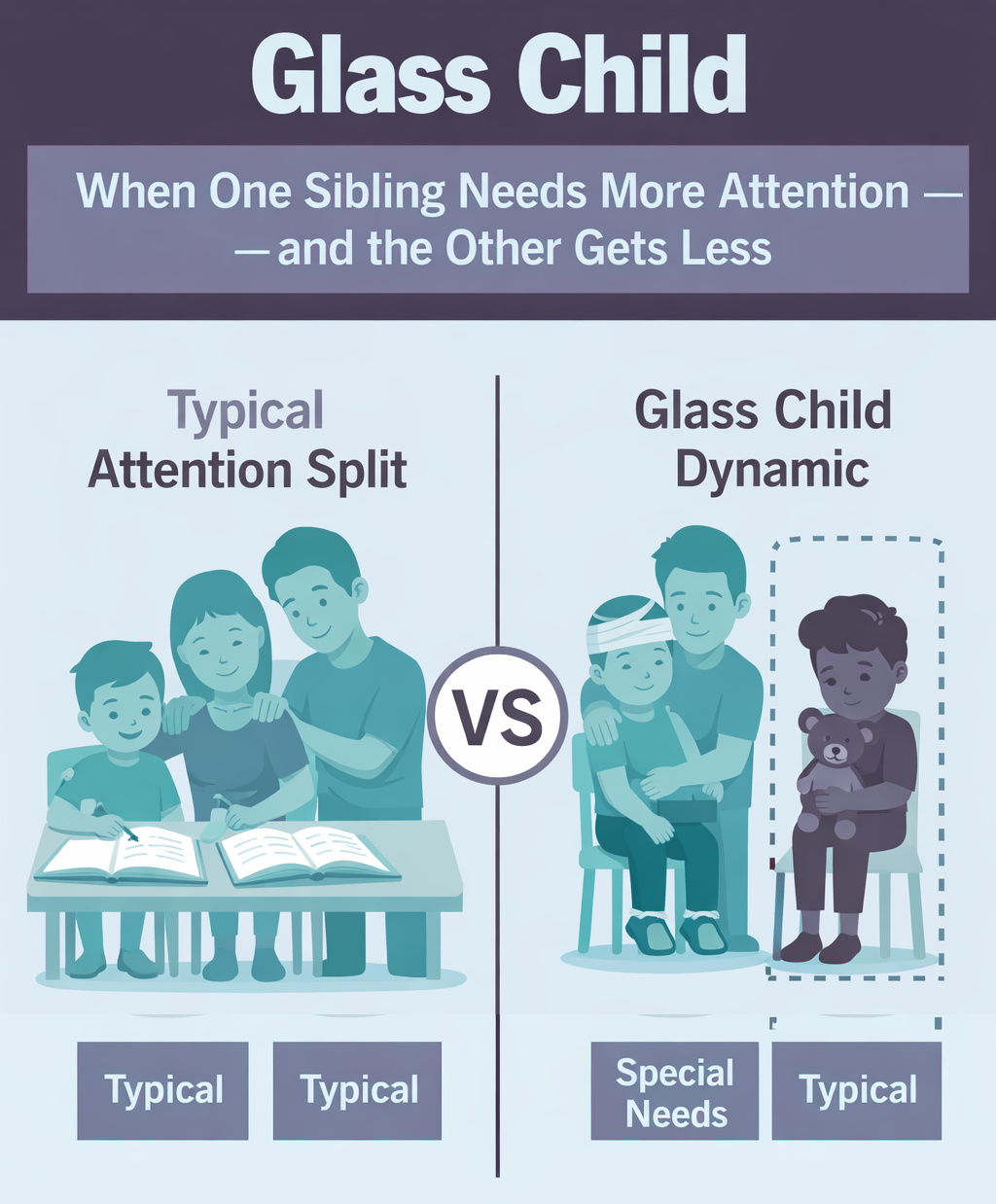
Glass Child Syndrome is an informal term used to describe the emotional experience of children who grow up alongside siblings with chronic illness, disability, or significant additional needs.
The term “glass child” reflects a painful reality many people recognise instantly:
parents are so focused on the child who needs the most care that they look straight through the other child, as though they are made of glass.
This isn’t about bad parenting.
It isn’t about lack of love.
It’s about capacity.
When families are dealing with medical appointments, therapies, fear, exhaustion, and survival, attention is triaged. The child with visible needs must come first.
The glass child adapts.
Why Glass Children Become Invisible
In families under pressure, children learn quickly what is rewarded and what is risky.
Glass children often discover that:
- expressing needs feels inconvenient
- having emotions feels like adding to the load
- being “fine” keeps things calm
So they adapt.
They become:
- independent
- responsible
- low-maintenance
- emotionally contained
Invisibility doesn’t mean failure. It’s a strategy.
For a child, disappearing emotionally can be a very intelligent way to survive. The problem is that strategies designed for childhood don’t automatically dissolve in adulthood.
The Adult Patterns of a Glass Child
Many adult glass children recognise themselves in patterns such as:
- Difficulty asking for help
- Suppressing needs or desires
- Fierce self-reliance
- Over-responsibility and perfectionism
- Guilt for needing anything
- Resentment followed by shame for feeling it
- Emotional numbness or emptiness
- Fear around pregnancy, childbirth, or parenting
- A deep sense of “something is wrong with me”
These patterns are often mistaken for personality traits. They’re not. They are adaptations.
READ: Childhood Wounds: How Early Experiences Shape Adult Patterns
Why Understanding Your Patterns Often Isn’t Enough
Here’s where many glass children get stuck. They understand themselves.
They can see why they’re independent.
They know why they struggle to ask for help.
They’ve talked it through.
They’ve reflected.
They’ve analysed their childhood.
And yet… the patterns remain.
This is because not all patterns are created in the same way.
Some behaviours are learned through upbringing, conditioning, and culture.
Others are formed in moments of emotional intensity – moments where fear, guilt, shame, or overwhelm are present.
When a child experiences something emotionally charged and makes an internal decision…
“I won’t do that again”
“I won’t need anything”
“I won’t cause problems”
…that decision can become locked into the nervous system.
At that point, the behaviour isn’t just learned.
It’s wounded.
And wounded patterns don’t fully release through insight alone.
A Real Example: When the Wound Is “Expressing My Needs”
I want to share an example that illustrates this clearly. I was working with a client on the wound of having needs.
She felt deep guilt about needing anything at all. She never asked for help, never made demands, never relied on anyone. Instead, she became highly self-reliant, responsible, and emotionally contained.
During the wound healing, I used the phrase “expressing my needs.”
At first, she felt resistance. She said it didn’t quite fit – because she never did that. She never expressed her needs. But as we continued, something clicked. She realised the wound wasn’t not expressing needs.
The wound was expressing needs.
At some point – likely very early, possibly before she had language – she must have expressed a need and experienced it as unsafe, ignored, overwhelming, or burdensome.
That moment carried emotional charge. And her system made a decision: “I won’t do that again.”
She couldn’t remember the moment because it likely happened pre-verbally. But her entire adult life had been shaped by it. Not asking for help wasn’t her personality. It was her solution.
This is why so many glass children say:
“I don’t remember anything bad happening – I just know I can’t ask.”
Wounds vs Behaviours: A Crucial Distinction
This distinction matters deeply for glass children.
Behaviours formed through upbringing and conditioning are often flexible.
Behaviours formed through emotional wounding carry charge.
The more emotional charge involved, the more stuck a pattern feels.
When the wound sits underneath the behaviour, the behaviour keeps regenerating – no matter how much insight you have.
This is why glass children often feel frustrated with themselves:
“I know where this comes from… so why can’t I change it?”
Because what needs healing isn’t the behaviour. It’s the wound that created it.
READ: Emotional Wounds and Behaviour Patterns: The Difference
The Core Glass Child Wounds
Through my work, I’ve found that Glass Child Syndrome consistently creates six core wound clusters.
These wounds sit underneath the coping strategies and adaptations.
1. Invisibility & Neglect
The wounds of being unseen, forgotten, or emotionally overlooked.
2. Needs Suppression & Self-Erasure
The wounds formed when having needs felt dangerous, burdensome, or unacceptable.
3. Rejection, Brokenness & Identity Damage
The fear that something is wrong with you – or that you might cause harm.
4. Responsibility, Obligation & Premature Adulthood
The wounds created by growing up too soon and carrying too much.
5. Grief, Loss & Emotional Desolation
Unacknowledged grief for what you didn’t receive – and couldn’t grieve.
6. Anger, Resentment, Guilt & Injustice
Suppressed anger, guilt for resentment, and the sense that none of this was fair.
These wounds are not flaws. They are the emotional imprint of a system that asked too much of you, too early.
Why Healing Has to Happen at the Wound Level
A glass child is often praised for coping. They’re called strong, mature, resilient, independent. So their adaptations are reinforced.
But beneath those adaptations are wounds formed in environments where:
- needs felt unsafe
- attention felt scarce
- expressing yourself felt like too much
Healing doesn’t mean undoing your strength. It means releasing the emotional charge that made that strength compulsory.
Healing Is Possible
These wounds are not permanent.
They are not defects and they are not evidence that you are broken (even though you might feel that way).
They are intelligent responses to circumstances you didn’t choose.
Healing doesn’t require blaming your parents.
It doesn’t require denying love or loyalty.
It doesn’t erase the bond with your sibling.
It simply allows choice where there was once only survival.
The Glass Child Healing Programme
This is why I created the Glass Child Healing Programme.
It is a structured, trauma-informed healing journey designed specifically for adults who grew up as glass children.
The programme works directly with the six core glass child wound clusters, helping to release the emotional charge that keeps these patterns in place.
It is self-paced, gentle, and designed for deep emotional repair – not surface-level coping.
👉 You can learn more about the Glass Child Healing Programme here.
You didn’t disappear because you didn’t matter. You disappeared because the system couldn’t hold everyone.
There is space for you now. And you don’t have to stay invisible anymore.

- How to Stop Anxiety (Without Medication or Mindfulness) - February 23, 2026
- You’ve Been in Therapy for Years. Why Do You Still Feel Broken? - February 19, 2026
- What’s Hidden in Your Car Boot? - February 14, 2026